

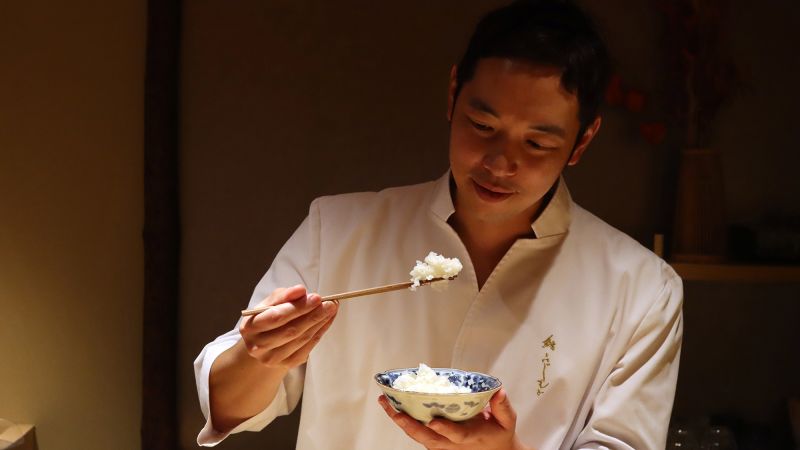
There’s more of the story at the article, but here I have compiled some excerpts about the rice, how rice is assessed, etc.
Usually, the chef would perform several test runs with a new rice to figure out the best soaking times, water levels and cooking temperatures. But with only 420 grams of Kinmemai Premium to play with, he’s had to improvise.
Fujimoto rinsed the rice for a mere second and soaked it for 30 minutes — 30 minutes less than the recommended time — before adding it to the pot.
His initial assessment? “Nice, clear color. I like it.” His wife Ai’s take? “Whoa. Shiny.”
“Like a diamond,” adds Fujimoto. “You can see every grain standing out, which usually indicates good quality. The shape is beautiful, and the aroma is nicely balanced — not too strong.”
Tasting it, he gives his approval.
“The flavor is well-balanced. The texture is good. It has nice moisture. This rice will appeal to everyone.”
Is he tempted to buy the rice for his restaurant?
“No, no, no. It’s too expensive — we’d have to triple our prices,” he laughs.
Like Toyo’s in-house chef, he also believes the rice is better served plain, more suited to a kaiseki restaurant, an establishment serving traditional refined dishes. “I think this rice isn’t really suited for sushi. It might get mushy if mixed with vinegar,” he says.
Chef Nansen Lai owns several Hong Kong restaurants including Flower Drum and Lai’s Kitchen – the latter of which specializes in clay pot rice. He also sampled the Kinmemai Premium, comparing it with his house blend — a mix of Thai fragrant rice and Koshihikari, another high-quality grain, from Japan’s Niigata prefecture.
“It looks stickier and doesn’t have as strong a rice fragrance as Thai rice, which is a normal difference between Thai and Japanese rice,” he says.
He takes a bite.
“It’s delicious, with a much more complex taste and flavor than our house rice,” says Lai, before inviting his staff to try it.
“From a restaurateur’s perspective, we can’t afford rice like this. We also need a firmer rice, like Thai rice, that can stand up to stronger sauces. But this rice is so tasty you could eat it plain.”